Carriers of Light and Labor
Carriers of Light and Labor: Audio Tour
Michelle Angela Ortiz explains the meanings, inspiration, and vision behind her monument, and how it reflects North Jersey community stakeholders’ stories of labor and migration.
Michelle Angela Ortiz explica el significado, la inspiración y la visión detrás de sus monumentos, y cómo refleja las historias sobre el trabajo y la migración de las comunidades del norte de Nueva Jersey.
A Monument for North Jersey’s Migrants and Workers
Inspired by Paterson’s industrial and labor history and the interwoven stories of migration that link communities across North Jersey, Carriers of Light and Labor makes visible workers’ many contributions to the region. It highlights the connection between our histories and possibilities, when we are able to imagine futures proudly and openly shaped by immigrants and immigration.
Carriers of Light and Labor is in the plaza in front of Paterson City Hall, facing Market Street, in the busy center of the city. The five monuments that form the installation correspond to conceptual “pillars” that Ortiz identified as common threads from public conversations with community members that occurred in the spring and summer of 2025. The pillars for the monuments are: Justice and Resistance; Sacrifice and Perseverance; Contributions; Ancestors; and Descendants. While each monument engages with distinct themes and ideas, they are also in rich conversation with each other, prompting the public to consider the pasts, presents, and futures of North Jersey’s immigrant and migrant workers and their communities.
Please click on the Resources Tab to learn more about the individual and historical photos that are featured in the monument.
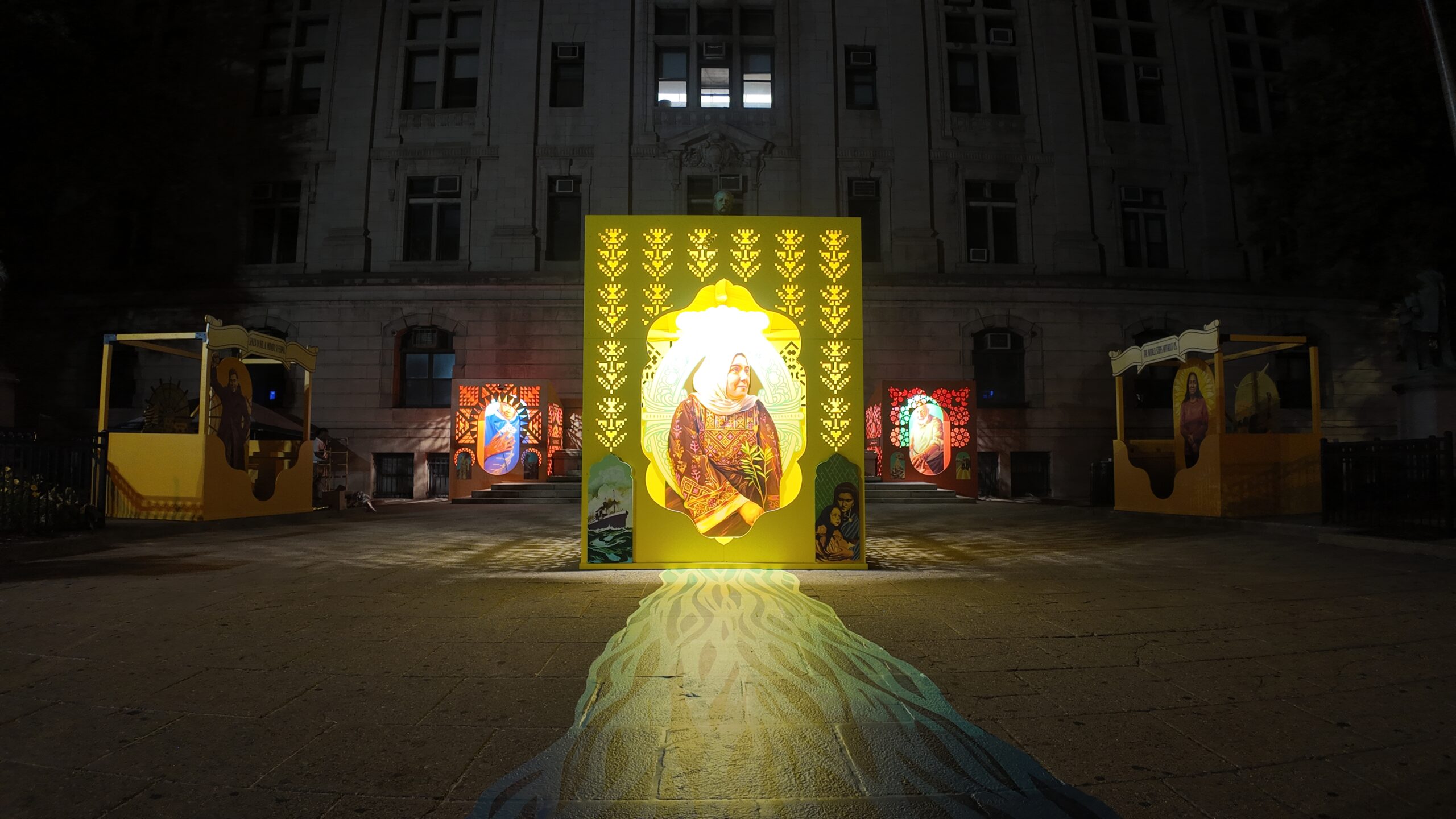
“What does the light represent? Is it something that is giving you clarity? Is it something that provides a memory or a connection? Or is it a prayer or hope that we want to have?”
— MICHELLE ANGELA ORTIZ
NJMML organized a series of community dialogues across the state in the spring and summer of 2025, including six at different locations in North Jersey. Dialogue facilitators, connected to immigrant and migrant communities, and to groups advocating on behalf of workers in New Jersey, guided stakeholders in discussions about how to commemorate and honor histories and personal narratives of migration and labor in the region.

Newark in April 2025.

Newark in April 2025.

Newark in June 2025.

Newark in June 2025.

Jersey City in August 2025.

Haledon in August 2025.
Artwork made by participants during community dialogues in North New Jersey; collected and archived by NJMML.
Ortiz highlights the importance of these community dialogues in shaping her ideas for Carriers of Light and Labor in the following audio clip:
Preliminary design rendering demonstrating the lighting feature of the monuments.
Ortiz led a series of three public events in the winter and spring of 2025/2026, during which she brainstormed with community stakeholders about the monument’s location, and received feedback on a concept proposal. She proposed Paterson City Hall because of its centrality. There is a busy bus stop right at the intersection in front of City Hall, so there is great potential for multiple publics to engage with the monuments. In the immediate area around City Hall, Ortiz witnessed the incredible diversity of Paterson, reinforcing her decision about the location. And, it would be inaccurate to claim that City Hall is like any other site. A grand, classical building and the active seat from which Paterson’s council and mayor govern, City Hall has weight as a venue from which to pose questions about history, memory, and representation - as numerous stakeholders noted.


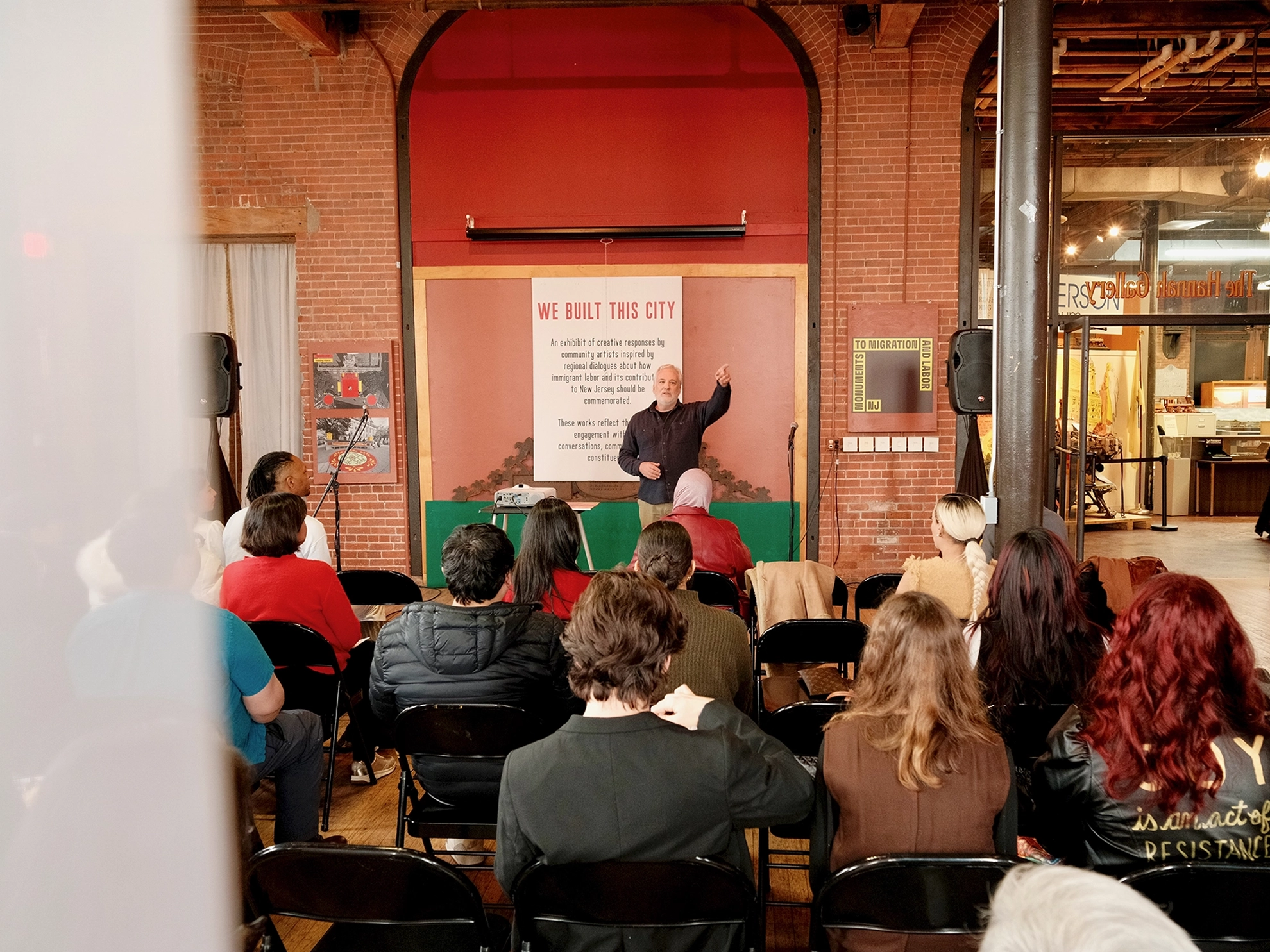
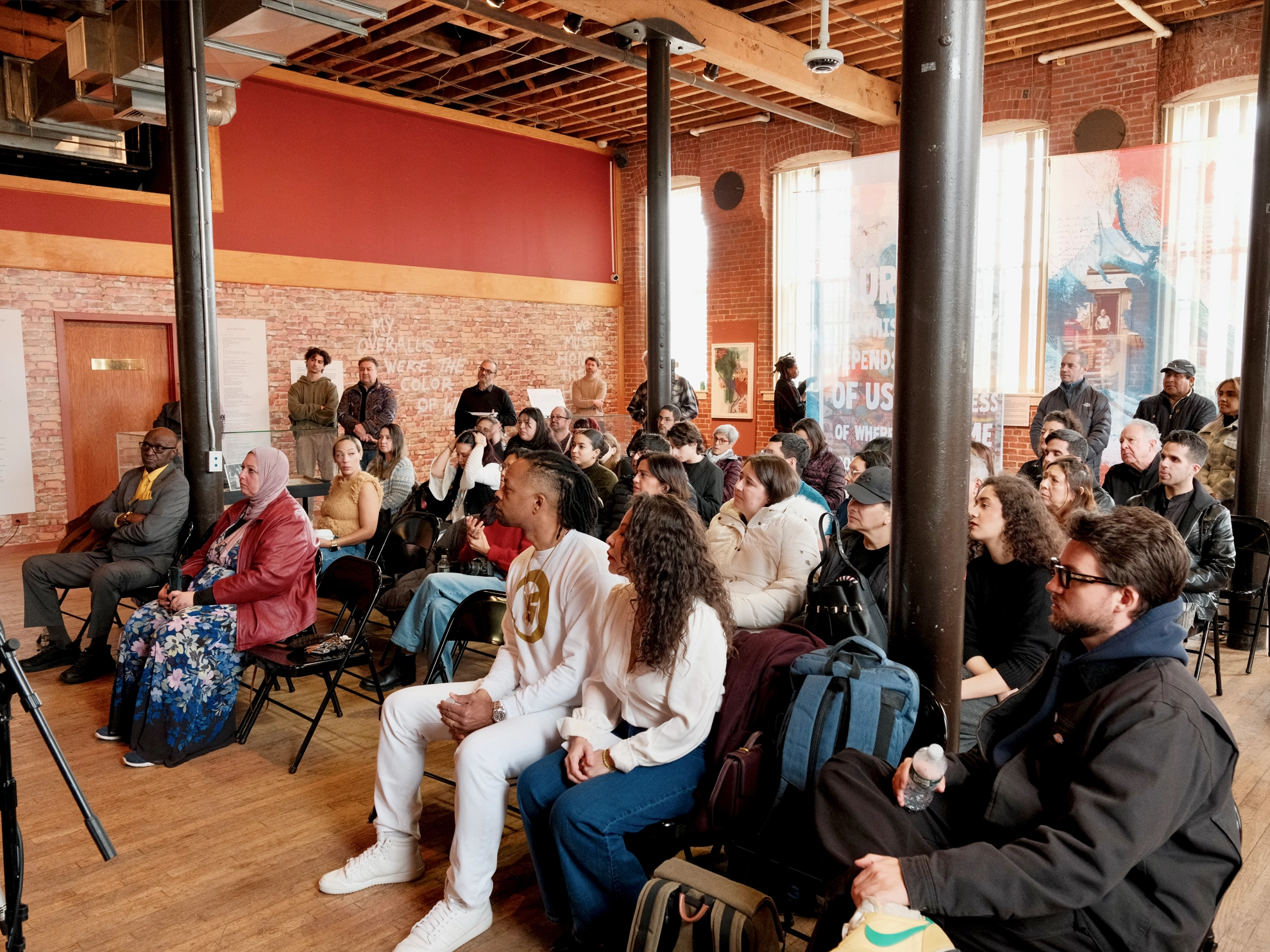
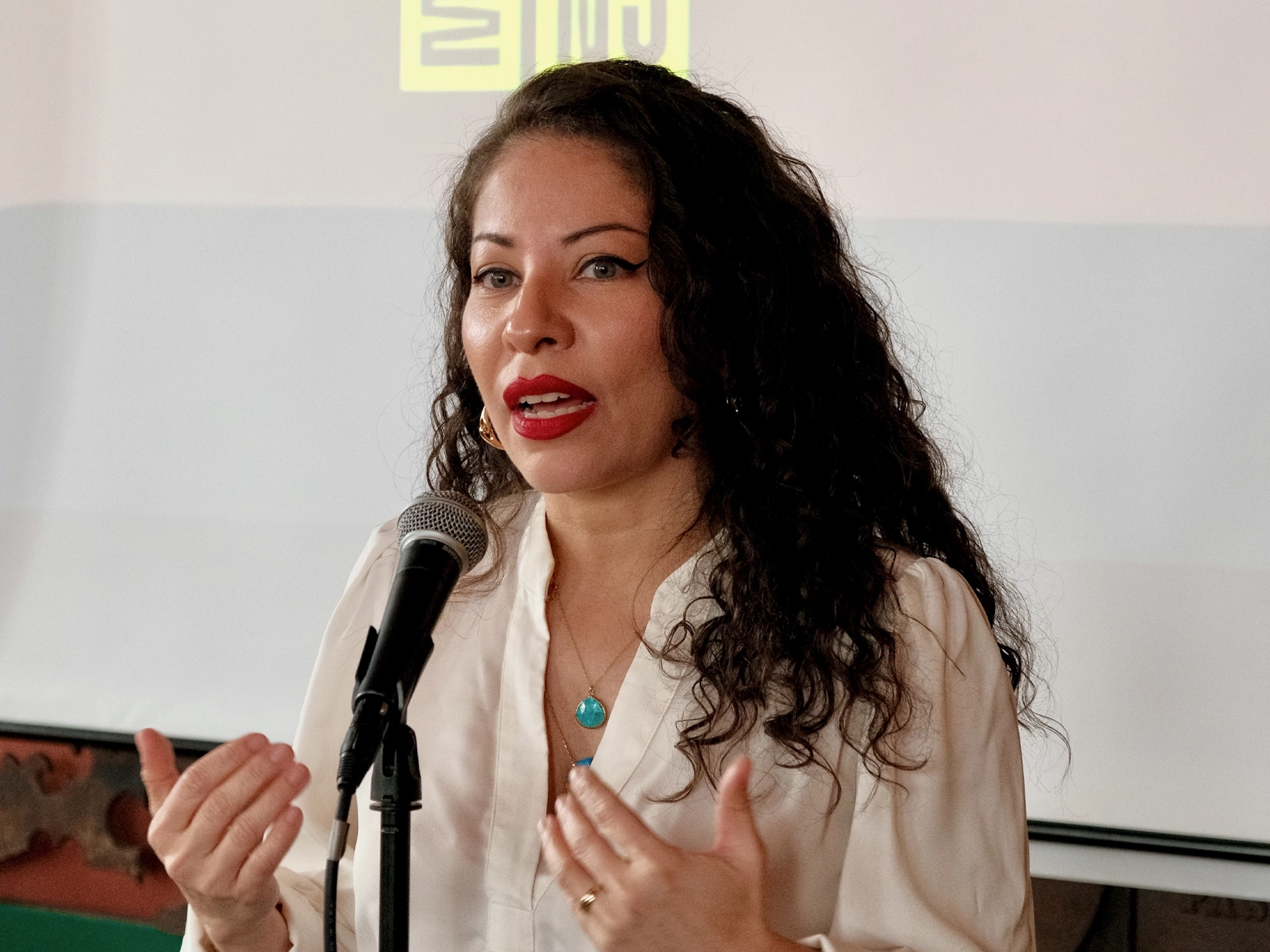
These photographs document the first community dialogue in Paterson in March 2025. They also capture the final public event held in March 2026 at the Paterson Museum, where the monument design to be installed in front of Paterson City Hall was unveiled.
Participants at the public events engaged in activities that aided in further developing and visualizing the conceptual pillars that the five monuments represent. Participants brought their family histories and migration stories to each conversation, cementing for Ortiz the importance of personal and historical archives to stakeholders. Archives’ role in communal and cultural preservation is expressed through the monuments as well.
On monumentality and the historical significance of the chosen location for Carriers of Light and Labor, Ortiz notes that “these new monuments are also having a conversation with what already exists there,” in the form of statues to figures who resonated with immigrants in the past. In thinking about the contributions of immigrant and migrant workers in North Jersey, Carriers is in conversation with space and history, and how space can be visually amended to reflect change
Renders

Layout of the plaza in front of Paterson City Hall indicating the placement of each of the five monuments.


Each monument structure features portraits of community stakeholders or archival images. The individuals in the portraits, and their stories, embody the concepts represented by the different monuments. The portraits are illustrated and embellished with visual imagery inspired by Ortiz’s engagement with community stakeholders and historical archives. In a nod to Paterson’s history as a textile-making hub and the intricate textile patterns that form an important part of the cultural traditions of immigrant and migrant groups who came to North Jersey, designs will be cut out of the monument structures, so that light can reflect through them. Similarly, colorful patterns made out of concrete vinyl will adorn the plaza, bringing to life a space that doubles as a bus stop.

2D design rendering of the first monument depicting a portrait of a community member in the center, flanked by an image of an ocean voyage to the left and an archival image of an immigrant mother and child to the right. The rendering also depicts the pattern and phrases cut into the wooden material that will appear on the sides of the structure.
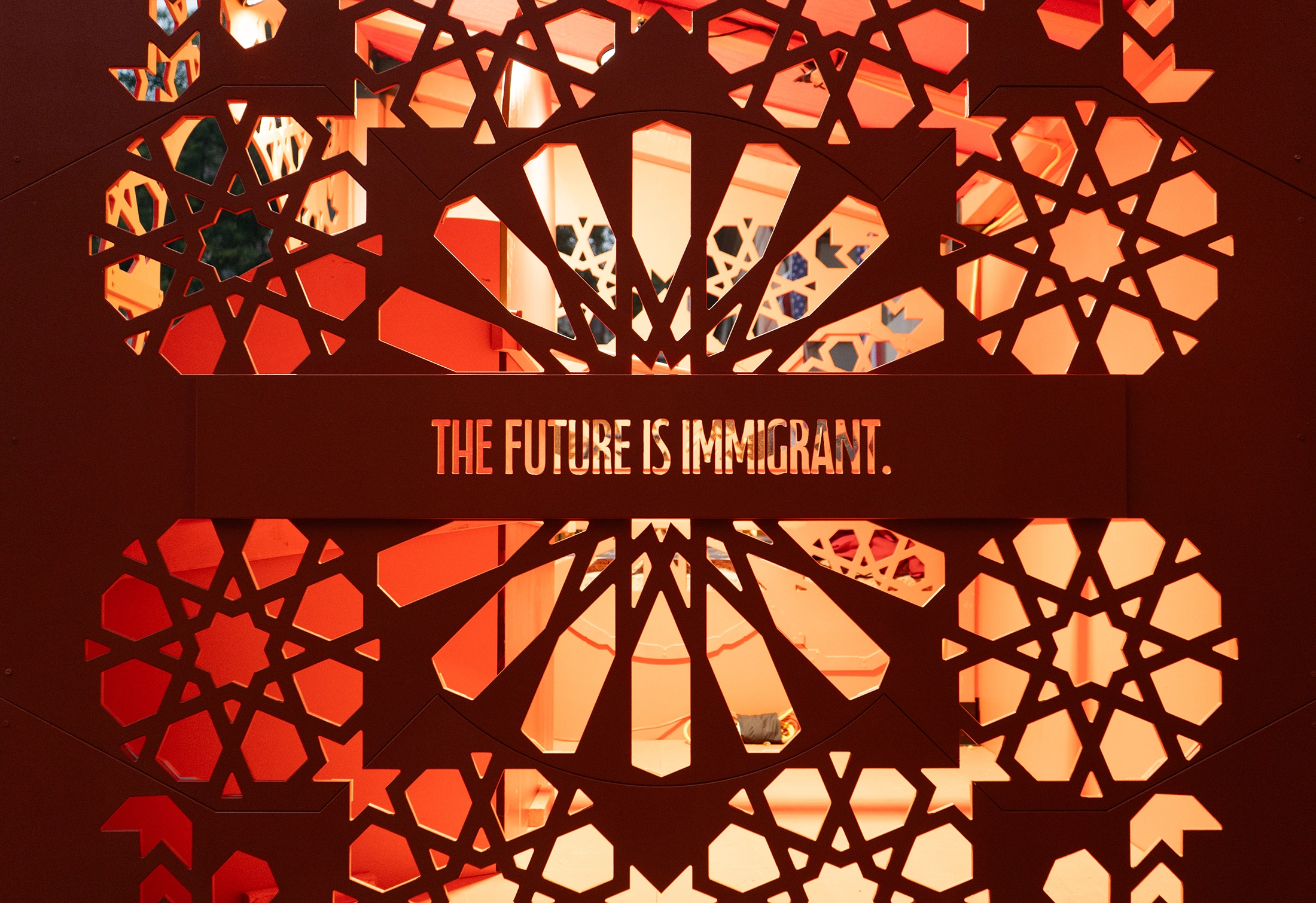
Accompanying the central portraits that each monument displays, are phrases and quotes that community stakeholders shared, to be cut out of the wood panels. The phrases further reflect the pillar each monument represents. At night, when all five structures are illuminated, the front of Paterson City Hall will shine. Ortiz shared that “I believe that our stories carry light. Through these monuments, I want to create a moment where light washes over the viewer.” In other words, not only are we celebrating workers, but they are shining upon us, as lights in the dark.

Design rendering of the first monument during the daytime.

Design rendering of the first monument illuminated at night.

Design rendering of a concrete vinyl strip to be placed on the bench on the left side of the plaza. A similarly designed concrete vinyl strip with the phrase in Spanish will be placed on the right side bench.
NJMML is excited to host a series of events and activities related to the unveiling of the monuments this summer, and programs that will animate these installations even further through the fall!
Please see below for information about the ribbon-cutting event for Carriers of Light and Labor, as well as a community art program scheduled for September. See this space for additional events as they are added!
Monumental Images
The sections below provide additional background and historical context to the visual images that artist Michelle Angela Ortiz has illustrated, examined, and incorporated into her monument, Carriers of Light and Labor. Jackie Lehrian, Tim Raphael, Andy Urban, and Lili Xu, with input from Ortiz, authored the text. Ortiz took the photographs featuring images and text from the monument.
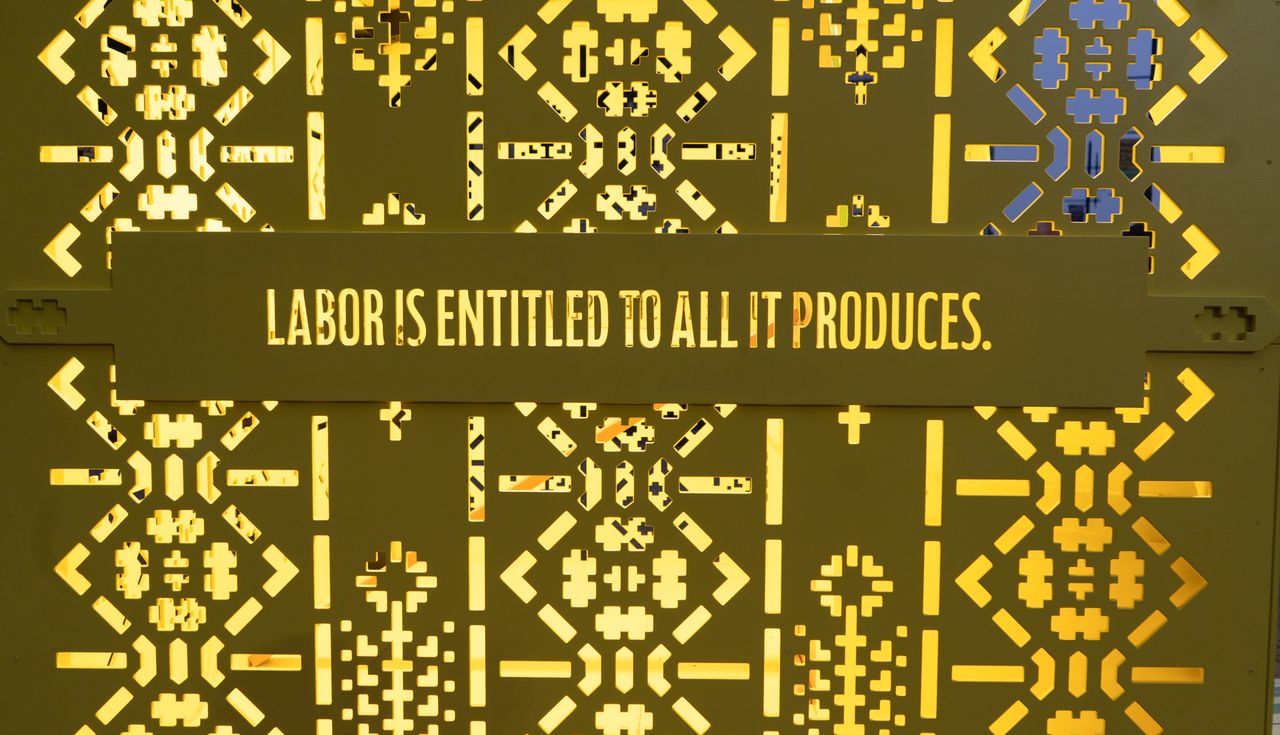
Monument 1: Justice/ Resistance
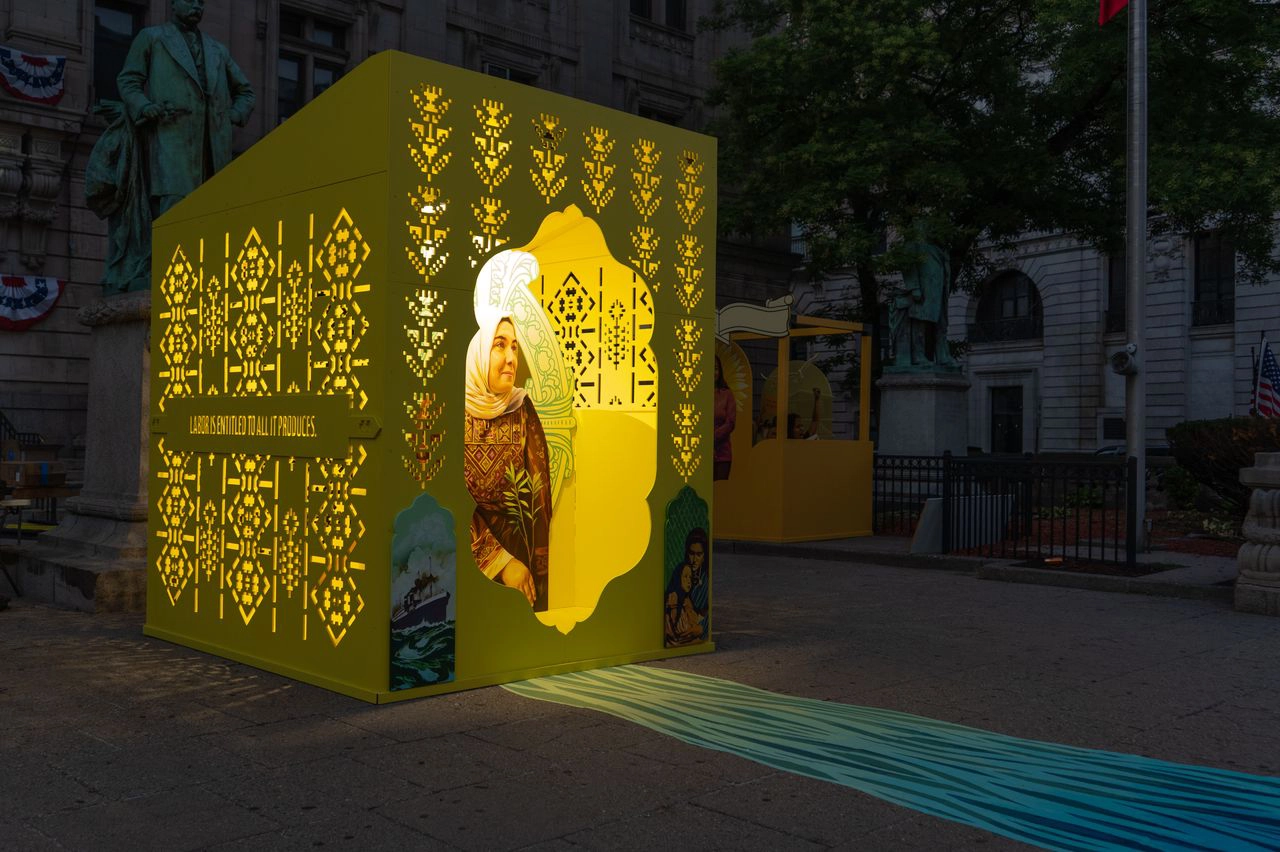
Rania Mustafa
Rania Mustafa is a Paterson resident and Executive Director at the Palestinian American Community Center. In Carriers of Light and Labor, Michelle has inserted Rania into the historic Seal of Paterson, replacing a male worker planting a white mulberry sapling – symbolic as the tree favored by the silkworms that produce raw silk - and centering a Palestinian woman instead. Rania appears planting an olive tree, which connects Palestine and Paterson through the acts of labor and cultivation. As all immigrants do, Rania is planting the seeds of family and community which take root in the soil of the new land. She wears a traditional Palestinian tatreez dress honoring women’s textile work and embroidery as an expression of embodied, intergenerational cultural memory. Her presence in the middle of the multi-paneled monument places women at the center of migration and labor histories and honors the cultural labor of transplanting life itself. The water pattern on the ground represents the Passaic River, and the many other bodies of water crossed by migrants and immigrants.
Lewis Hine, "Mother and child, Italian Ellis Island, 1905"
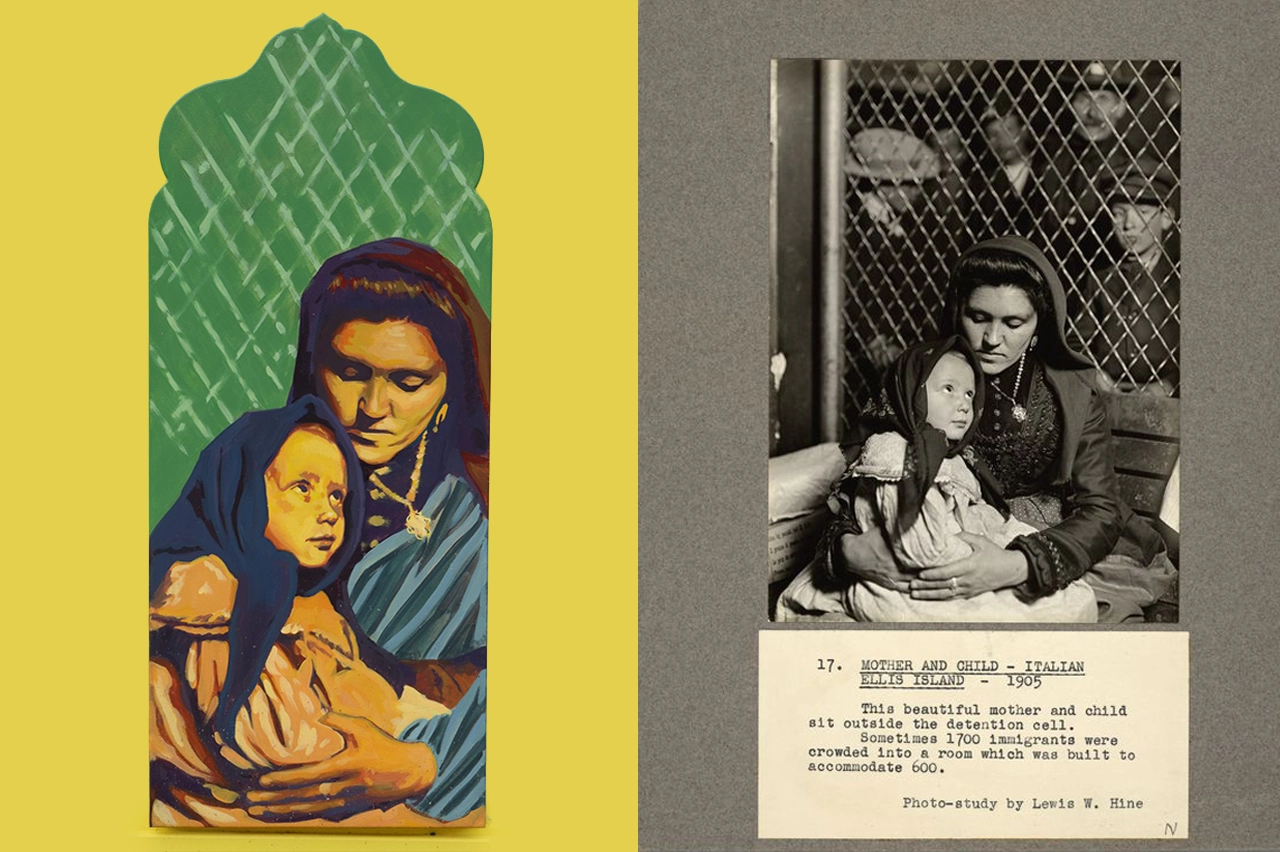
Lewis Hine, "Mother and child, Italian Ellis Island, 1905," The Miriam and Ira D. Wallach Division of Art, Prints and Photographs: Photography Collection, The New York Public Library Digital Collections.
The Wisconsin-born American sociologist and photographer, Lewis Hine, first travelled to Ellis Island in 1905, the year this image was taken. Then a faculty member at the Ethical Culture School in New York City, Hine, like many native-born Americans of the era, was obsessed with the immigration station as a place where the future character of the United States might be deduced from the study and observation of newly arriving immigrants. Hine claimed to view Ellis Island as a site and place that was to be held in the same regard as Plymouth Rock. The belief that he was capturing moments that were monumental to the nation’s history suffused Hine’s work and the perspectives he manufactured.
This photograph by Hine also carried an alternate title that appears with other prints: “Ellis Island, Italian Madonna.” Hine’s staged visual reference to the “Madonna and Child” motif that was a standard, recurring feature in Christian art since the Middle Ages, is clear. Like the tradition it alludes to, the photograph possesses both universal qualities, in terms of capturing a human mother’s attempt to care and comfort for her child, while at the same time suggesting that poor immigrants could represent something more transcendent altogether.
Hine’s text indicates that the photograph was taken outside of the overcrowded detention cells that were part of the main Ellis Island building and used to hold immigrants who had either been temporarily denied the right to enter the United States, or who had been barred entry altogether, but were appealing the decision. Detainees awaiting the resolution of a medical issue were usually held in Ellis Island’s hospital facilities. With the mother and child Hine photographed, the reason for their detention goes unstated, and it is unknown if they ever entered the United States officially. The mother may have been detained under suspicions that she was “likely to become a public charge,” which was the most common reason immigrants were barred from entering upon arrival at Ellis Island. Immigrants had to demonstrate their physical, mental, and practical ability to support themselves through labor, and a woman with a young child who could not demonstrate that she was supported by a male wage earner or had childcare enabling her to work outside the home may have been flagged for these reasons. Or the woman and child photographed might have been held while awaiting a male relative or the woman’s husband. Women and their dependents, when travelling alone, were not permitted entry until a male guardian, with identification papers, received them, and they were officially released as dependents.
Family separation was a frequent occurrence at Ellis Island. It is difficult not to think about other visual monuments to this immigration history, and immigration officials’ practices, from both the past and present, of separating parents from children due to different legal statuses. As detainees imprisoned in the ICE facility in Newark, Delaney Hall, wrote in a public letter published by the immigrant rights’ organization Cosecha in May 2026, the psychological damage caused by being put in indefinite detention was often as bad as the physical toll that inhumane treatment took on them. In numerous instances - as may have been the case with Italian immigrant mother and child, photographed by Hine - contemporary immigrants sometimes have no idea why they were confined, or where they might be sent: “The pain and fear are taking a physical toll on us, we are losing our hair, some of us are suffering from anxiety attacks, we cannot sleep, and we have no energy for anything. We are depressed from being separated from the people we love.”
For more information on Lewis Hine’s Ellis Island photography, see Anna Pegler-Gordon, In Sight of America: Photography and the Development of U. S. Immigration Policy (Berkeley: University of California Press, 2009), 150-173. Cosecha’s “We Demand Justice” project can be accessed at: https://www.lahuelga.com/justice.
Monument 2: Sacrifice/ Perseverance
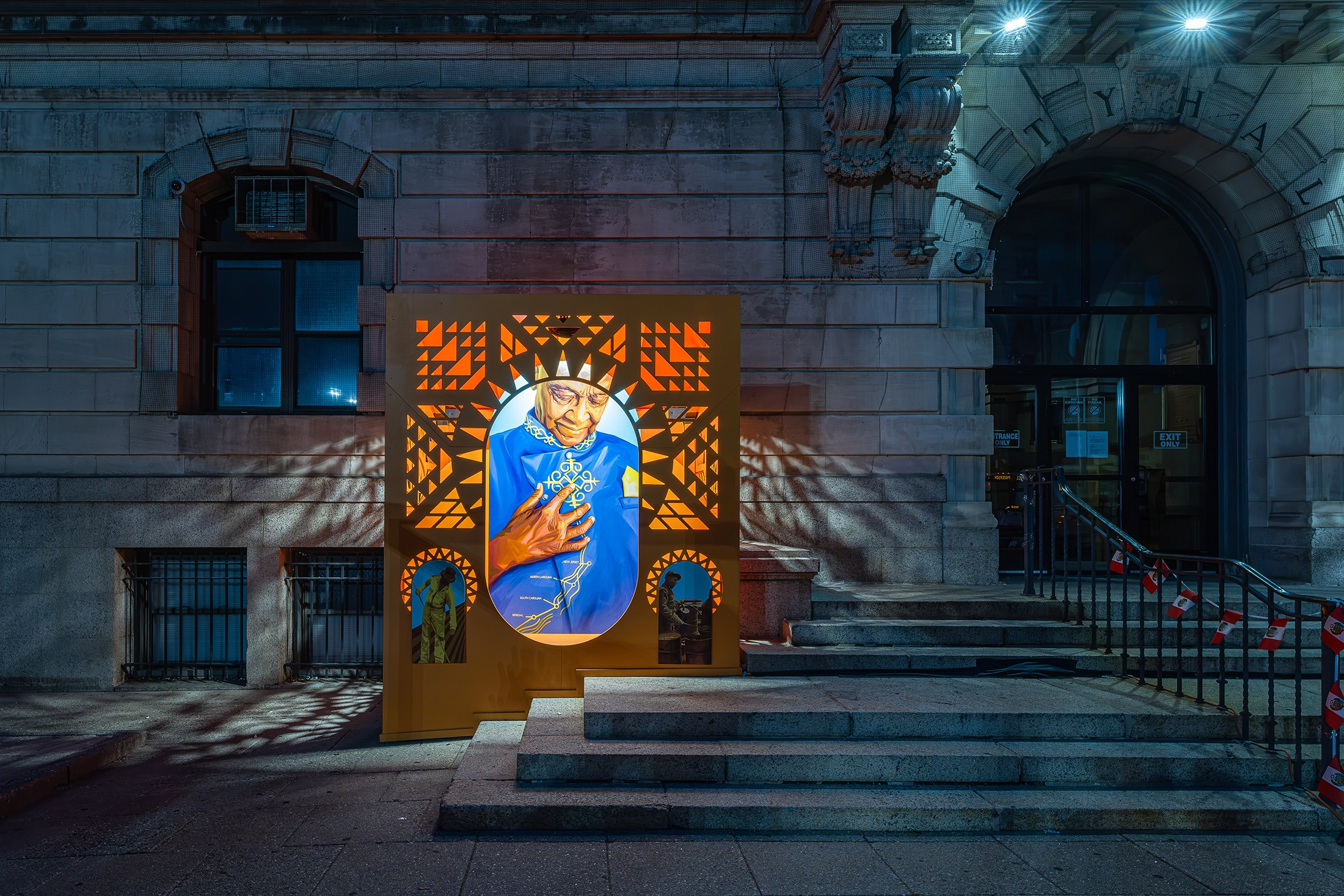
Photo by Steve Weinik.
Dr. Joseph Fulmore Sr.
Dr. Joseph Fulmore Sr. is a lifelong educator who dedicated his career to the Paterson Public School District, where he served as a classroom teacher, principal of Public School No. 6, and Assistant Superintendent. Although his family migrated from the Carolinas to Paterson during the Great Migration, Dr. Fulmore’s garment draws on traditional West African dress connected to his Senegalese ancestry, and the map on his shirt traces his ancestors’ journey from Senegal to the Southern United States, as enslaved Africans, and the migrations made by more recent generations to New Jersey. The image of Dr. Fulmore connects Black labor in Northern New Jersey to histories of migration from the US South to the North, which shared many of the social and cultural features that defined the experiences of immigrants crossing national borders in the twentieth century and beyond. Dr. Fulmore’s monumental appearance centers education as a form of labor, care, and community-building through the figure of a much-beloved community elder and project stakeholder.
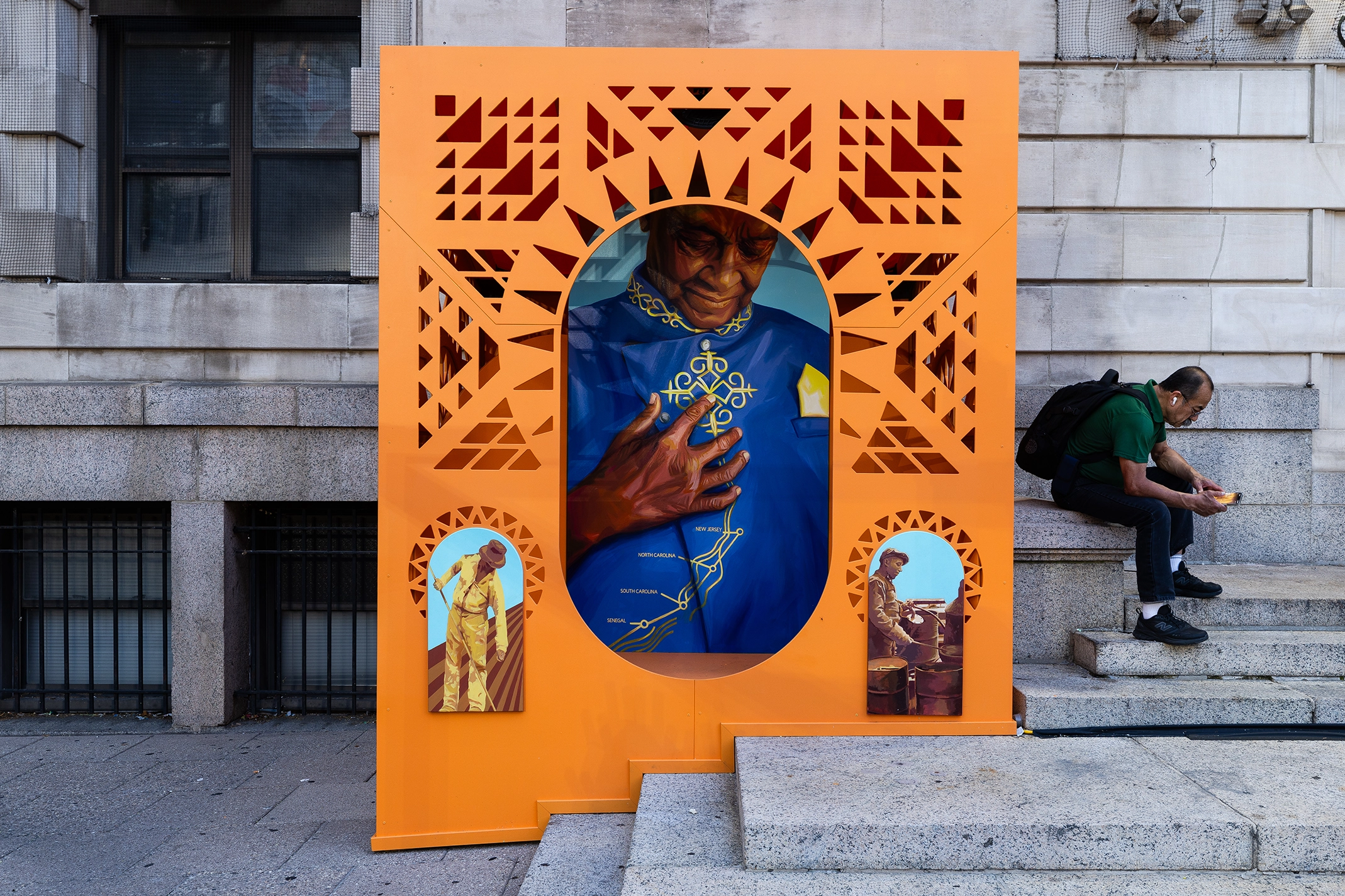
Photo by Steve Weinik.
Dr. Fulmore's achievements as an educator build on a longer history of Black labor and migration. For many families who settled in northern New Jersey, the path to educational opportunity began with the Great Migration, and the belief that there were better paying jobs and more opportunities in the North. Many of the Black migrants who came to New Jersey had been directly employed as sharecroppers in the South, performing agricultural labor, which this structure also commemorates.
Agricultural Workers
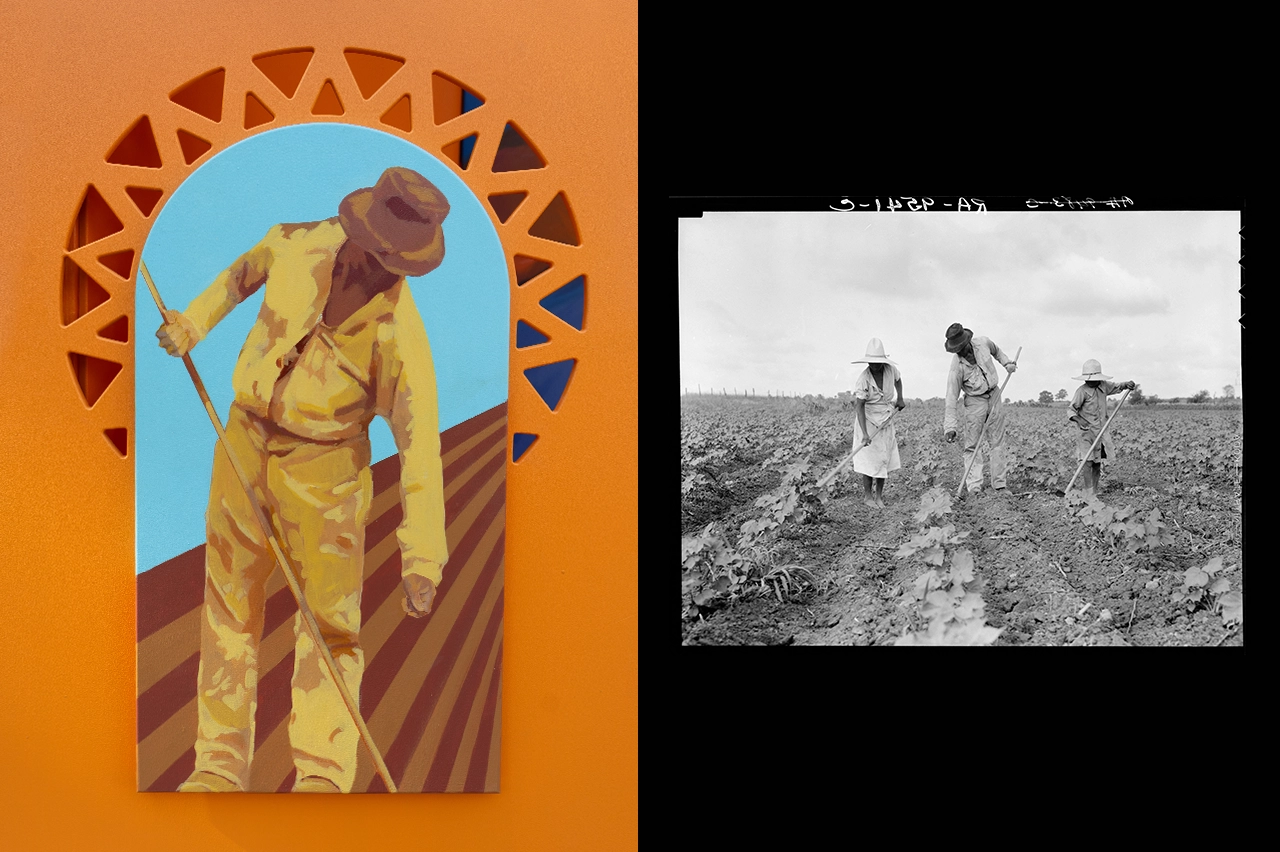
Dorothea Lange, “A Negro tenant farmer and several members of his family hoeing cotton on their farm in Alabama,” Farm Security Administration/Office of War Information Black-and-White Negatives, 1936.
In oral histories and newspaper interviews discussing Black histories of migration to northern New Jersey during the Great Migration, it was common to hear speakers identify as the children of sharecroppers. References to sharecropper roots are both statements of literal fact but also intended to evoke, for purposes of collective identification and commemoration, the difficult journeys from South to North that parents, grandparents, or great-grandparents made in the period of 1910 to 1970. In Southern states, Black sharecroppers toiled in fields growing commodities like cotton and tobacco, as tenant farmers. If they managed to avoid predatory white landlords who sought to cheat them out of profits, they still faced low prices, bad growing conditions caused by weather and insect infestations, depleted soils, and above all, debt, as barriers to survival. If they somehow managed economic success, Black southern sharecroppers still had to contend with Jim Crow racism, segregation, and violence.
Photo by Steve Weinik.
Deacon Willie Davis, one of the founders of the Green Acre Community Garden in Paterson’s Fourth Ward, was born on his parents’ sharecropping farm in North Carolina in 1950, before migrating to Paterson when he 18 years old, and sees cultivating fresh produce and making it available to city residents as an act that honors Black agricultural traditions that exist outside exploitative histories of sharecropping. Davis’s farming in Paterson instead is a collaborative endeavor aimed at building healthy communities.
Some Black Southerners performed agricultural labor for wages. Martha Gaynor, who came to Newark from Irwinville, Georgia, as a ten-year-old in 1926, told the Kreuger-Scott Oral History project in 1995 that she remembers her mother being a “champion” cotton picker, and how she and her brother were enlisted to help pick three-to-four hundred pounds of cotton in a single day, to maximize the piecerate return in payment. Nonetheless, wages in domestic service, the occupation Black women were most likely to work in once they arrived in Northern cities, typically paid more than what even the most efficient picker could earn.
Industrial Labor
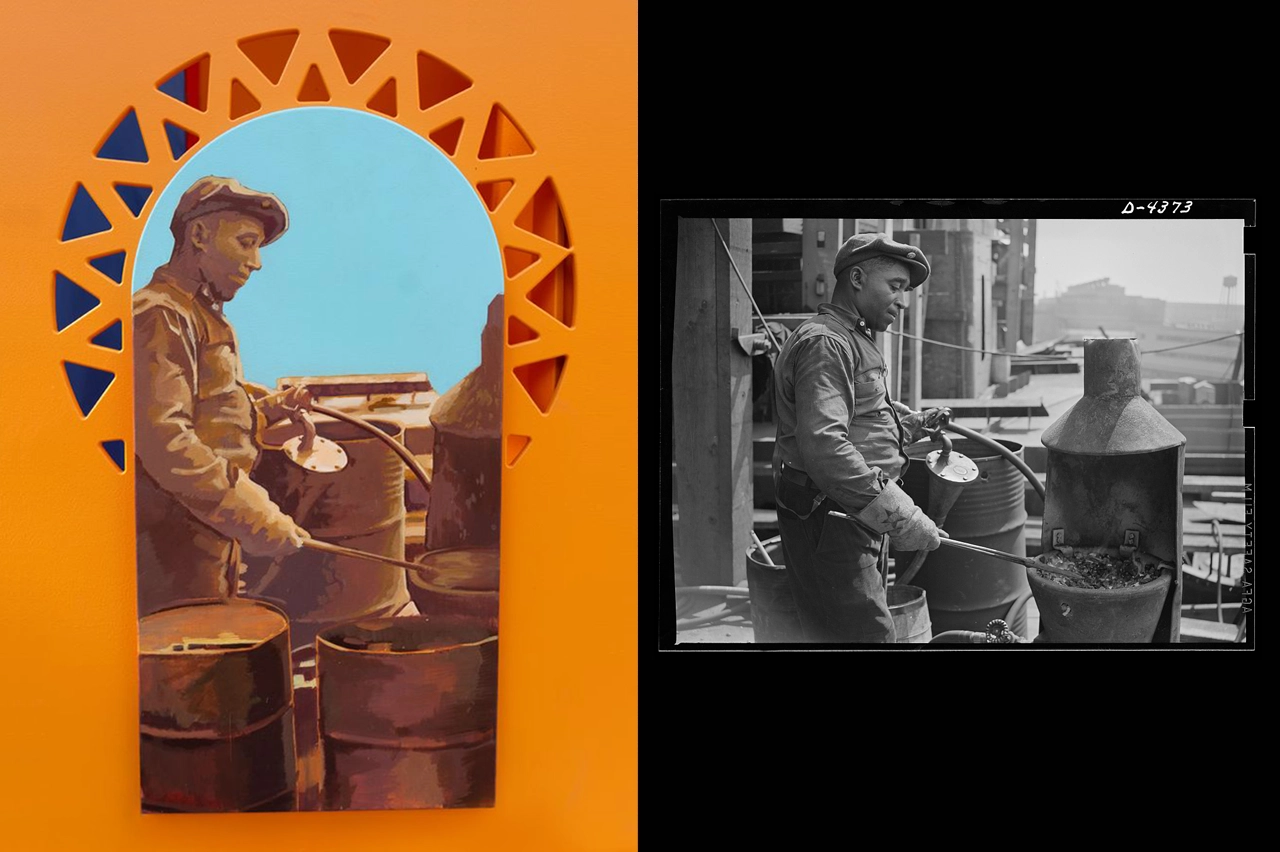
Howard Liberman, “Manpower,” 1942, Farm Security Administration - Office of War Information Photograph Collection, Courtesy of the Library of Congress.
Kearny Point, the peninsula where the Hackensack and Passaic Rivers converge into the northern part of Newark Bay, was once home to the Federal Shipbuilding and Drydock Company, the workplace where this photograph was taken. The Federal Shipbuilding and Drydock Company, a subsidiary of U.S. Steel, had its origins in the First World War, when the federal government commissioned its construction to build ships for the navy. During the Second World War, the facility was one of the busiest and largest in the entire United States, employing more than 50,000 workers in total, in around-the-clock shifts.
Although many Black Southern migrants were drawn to New Jersey by factory jobs that promised higher wages, they encountered systemic discrimination in hiring. When factory jobs were available at all, they tended to be non-unionized, temporary, or at the very bottom of the workplace hierarchy. In May 1942, Frank Tucker, reporting on New Jersey for the New York Amsterdam Star-News, a Black newspaper based out of Harlem, reported that despite the state’s reputation for “northern liberality,” major industrial employers such as Colgate-Palmolive in Jersey City, Johnson & Johnson in New Brunswick, RCA in Camden, and the Federal Shipbuilding and Drydock Company in Kearny, all hired only a handful of Black workers. Far more Black men could be found working in service-oriented jobs as porters. “No greater single pre-war example of the standing of Negro labor exists,” Tucker wrote, “than the fact that the elevator operators at Bamberger’s Department Store in Newark were generally regarded as the ‘cream of the crop’ among Negro workers.” With the war, Tucker was optimistic that change, prodded by the federal government’s more active interventions, could be achieved.
At the Federal Shipbuilding and Drydock Company, the Industrial Union of Marine and Shipbuilding Workers of America, a local affiliated with the CIO, was considered to be racially progressive, and in favor of racial integration. In 1943 the union negotiated a new contract that stipulated that ten percent of the workforce at the company’s Kearny facility, and ten percent of the workforce at its Newark facility, were to be composed of Black workers – a percentage approximate to the Black population’s relative size in Hudson and Essex Counties. This announcement was likely what drew Liberman, a photographer employed by the federal government, to come and take pictures of Black riveters that gestured toward what an integrated, multiracial defense effort could look like.
In 1948, Federal Shipbuilding and Drydock Company closed its shipbuilding facilities, and for many years the site was used as a maritime scrapyard, with a greatly reduced workforce. Many of the Black migrants who came to northern New Jersey, and had fought for the chance to be hired into well-paying, unionized factory jobs, never truly benefitted from the era of Fordist mass production in New Jersey. Already by the 1950s, capital was seeking strategies of flexible accumulation and production, with manufacturing facilities abandoning New Jersey for states with lower labor costs.
Monument 3: Contributions
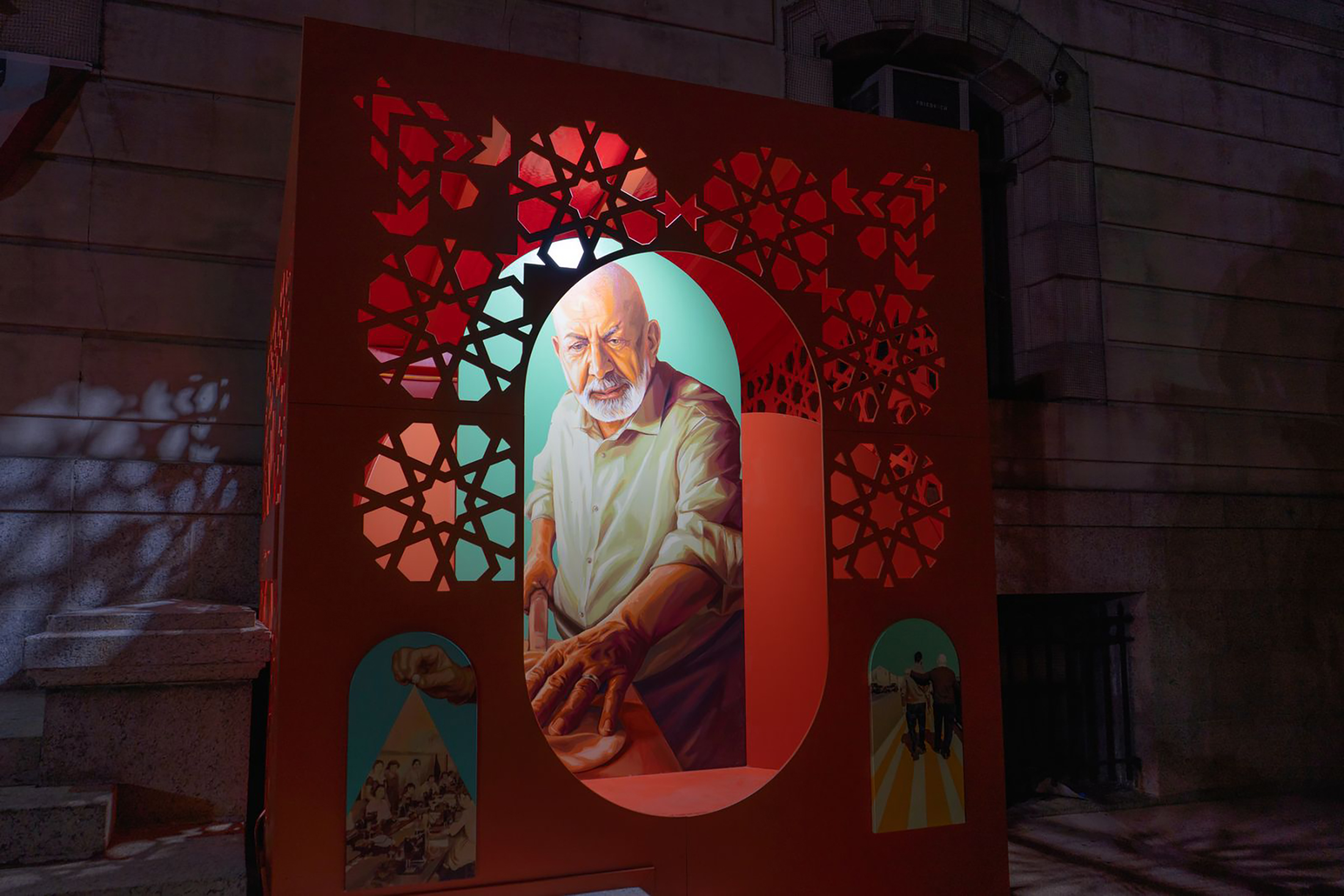
Edmond Fattal
Pictured in the center of “Contributions” is Edmond Fattal, who is holding a traditional bread-making paddle—a tool of immigrant labor and entrepreneurship. In 1968, the Fattal family emigrated from Aleppo, Syria, to Paterson, NJ. With little money in their pockets but a family of seven to feed, they brought their renowned family recipe for pita bread and Middle Eastern baked goods to the Patterson community, eventually drawing customers from far beyond the area. Fattal’s Bakery has remained family-owned and run since 1968, with the second and third generations of the Fattal family now operating the store - which in turn is beloved by multiple generations of loyal customers.
The Nouris: Nourishing Historical Memory
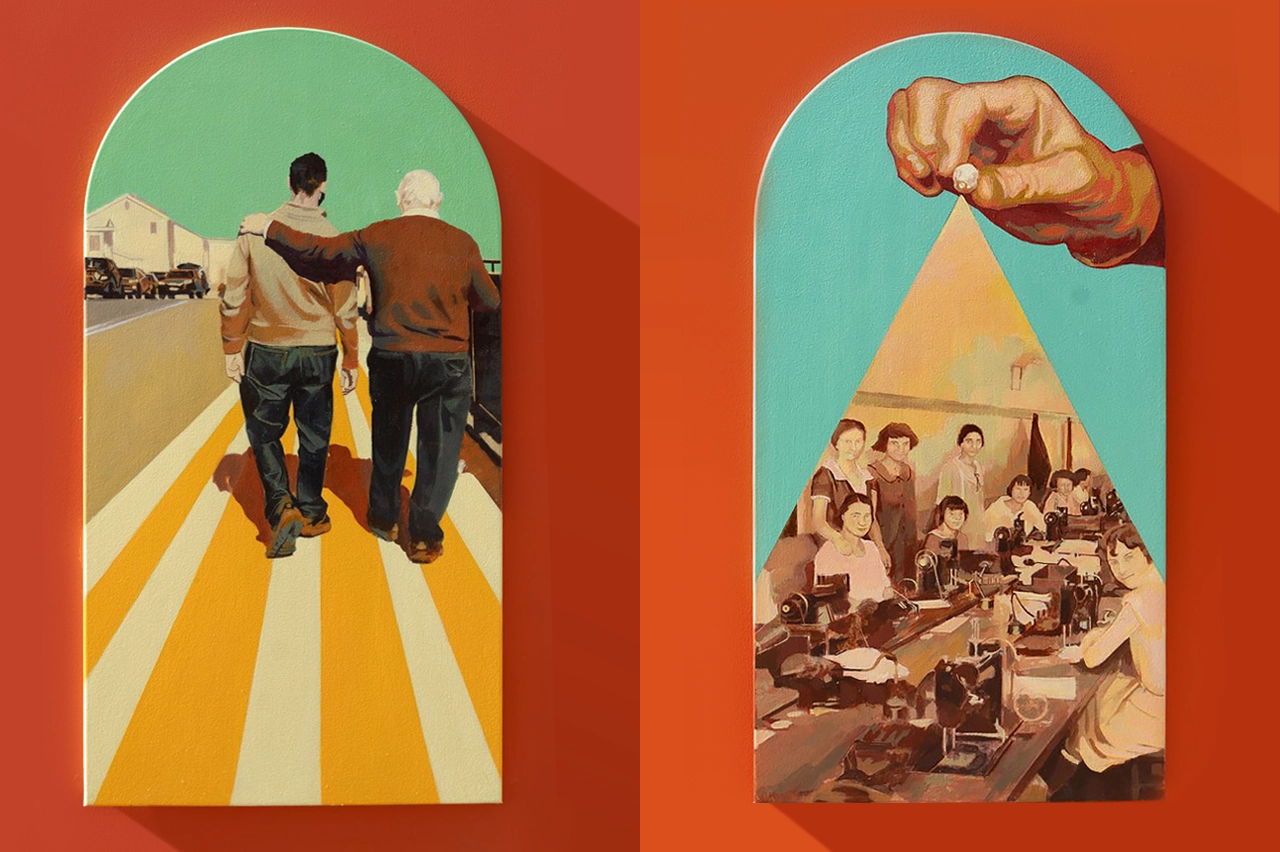
In “Contributions,” Michelle laces together the story of the Fattal family with that of the Nouri family. The Nouris are the owners of Nouri’s Restaurant, a family-owned American-Syrian cafe that has been an anchor of the South Paterson neighborhood since 1978. The image on the right reveals Abed Nouri and his son George walking together, down a Paterson street. Their gestures and familial intimacy help viewers imagine the passing down of generational knowledge, support, and responsibility.
Images featuring hands connect all three panels in “Connections.” The image on the left shows a hand holding a single chickpea that radiates rays of light onto the archival image, “Room of women at sewing machines” (described below). Here, the chickpea, symbolic as a central ingredient in the cuisines of numerous Arab American groups, connects more recent immigration to earlier waves of immigration from the Middle East, and the work of Armenian, Lebanese, Palestinian, and Syrian immigrants did with their hands in the textile factories and mills of New Jersey and other states of the Northeast. For the broad, diverse Syrian diasporic community in America, hands are literal instruments of building, shaping, and maintaining a new life. With the labor of hands, multi-generational and multi-ethnic lineages, families, and futures can grow together from something as small as a chickpea.
Arab American Labor History
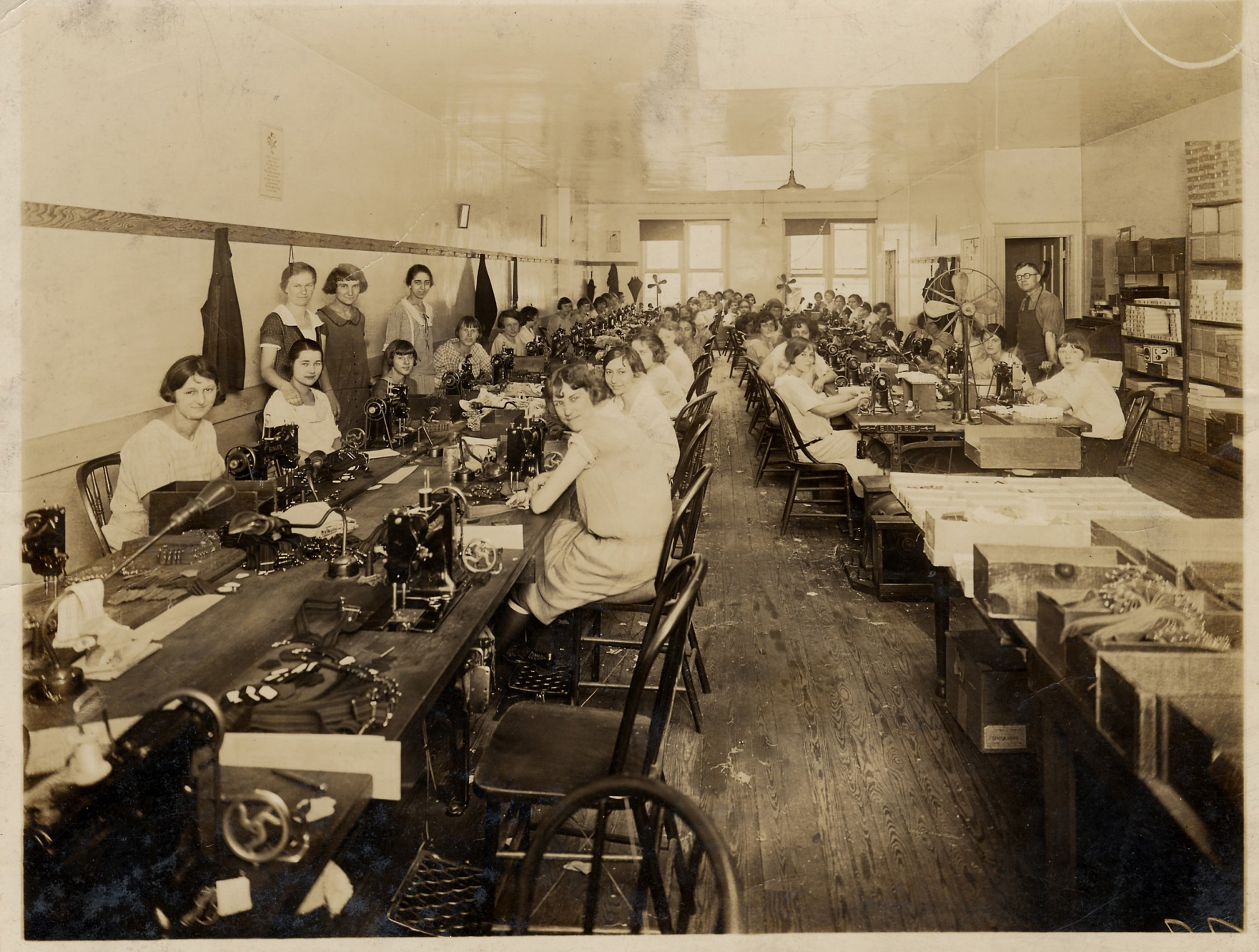
“Room of women at sewing machines, ca. 1930 (photographer unknown),” Faris and Yamna Naff Arab-American Collection Archives Center, National Museum of American History.
The exact provenance of this photograph is unknown. It belonged to Dr. Alixa Naff, the daughter of Syrian-Lebanese immigrants and one of the first formally trained scholars of Arab American history. It was donated to the Smithsonian’s National Museum of American History with Naff’s research papers. It was likely given to Naff by someone whom she conducted an oral history with, since one of the topics she explored was the involvement of Syrian, Lebanese, and Palestinian immigrants in the garment and textile industries.
If the stories of the Fattal and Nouri families highlight the labor of food work by Syrian immigrants in North Jersey, then the inclusion of “Room of women at sewing machines” highlights the labor of Syrian immigrants in the factories and garment trade. By 1900, Paterson, along with cities like Lawrence and Worchester, Massachusetts, was viewed as an important industrial destination for the "mahjar", or Syrian diaspora. Researchers investigating Syrian immigration on behalf of Congress noted that Paterson, along with these other cities, was unique as one of the emergent sites of a “Syrian-American proletariat,” and the population there defied stereotypes about the Arab immigrant population in this period being made up entirely of merchants and itinerant peddlers. Najila Nouhan Simon came to Paterson in 1913, when she was just fourteen years old, from Damascus, and got a job in silk weaving.
Over the course of five years, she learned the trade and safeguards against employers’ sly attempts to engage in wage theft, and eventually earned $16 a week, which she called “man’s wages.” It was far easier, Simon noted in an oral history with Naff, for her to earn money than for her father. Women workers might even make an additional three to four dollars a week if they were willing to take home additional work for manufacture in the “wooden shacks” where Syrian immigrants lived in Paterson, dwellings that were owned by the mills. In Unmentionables: Textiles, Garment Work, and the Syrian American Working Class (Stanford University Press, 2025), historian Stacy Farenthold explores the complicated and multifaceted ways in which members of the Syrian diaspora participated in the garment and textile trades. Syrian immigrant workers labored in large factories, where their willingness to battle on picket lines earned the praise of IWW union leader Bill Haywood. Syrian men and women in New Jersey were also employed in so-called “Syrian shops” owned by fellow immigrants. As Farenthold notes, “the textile work carried out by Syrian women in America in the early twentieth century represented a new form of labor commoditization, transforming work that was once done within households into standardized, industrial production.” Finally, there were a significant number of Syrian retailers and manufacturers who specialized in fashionable silk goods such as kimonos. Assy Shaheen and his sons, immigrants from Mount Lebanon, first established a shop in New York City and then later opened a special silk processing facility in Cranford, New Jersey in 1909. There, raw imported silk – supplied through a global network of Syrian and Lebanese merchants – was processed for kimono production.
Monument 4: Ancestors
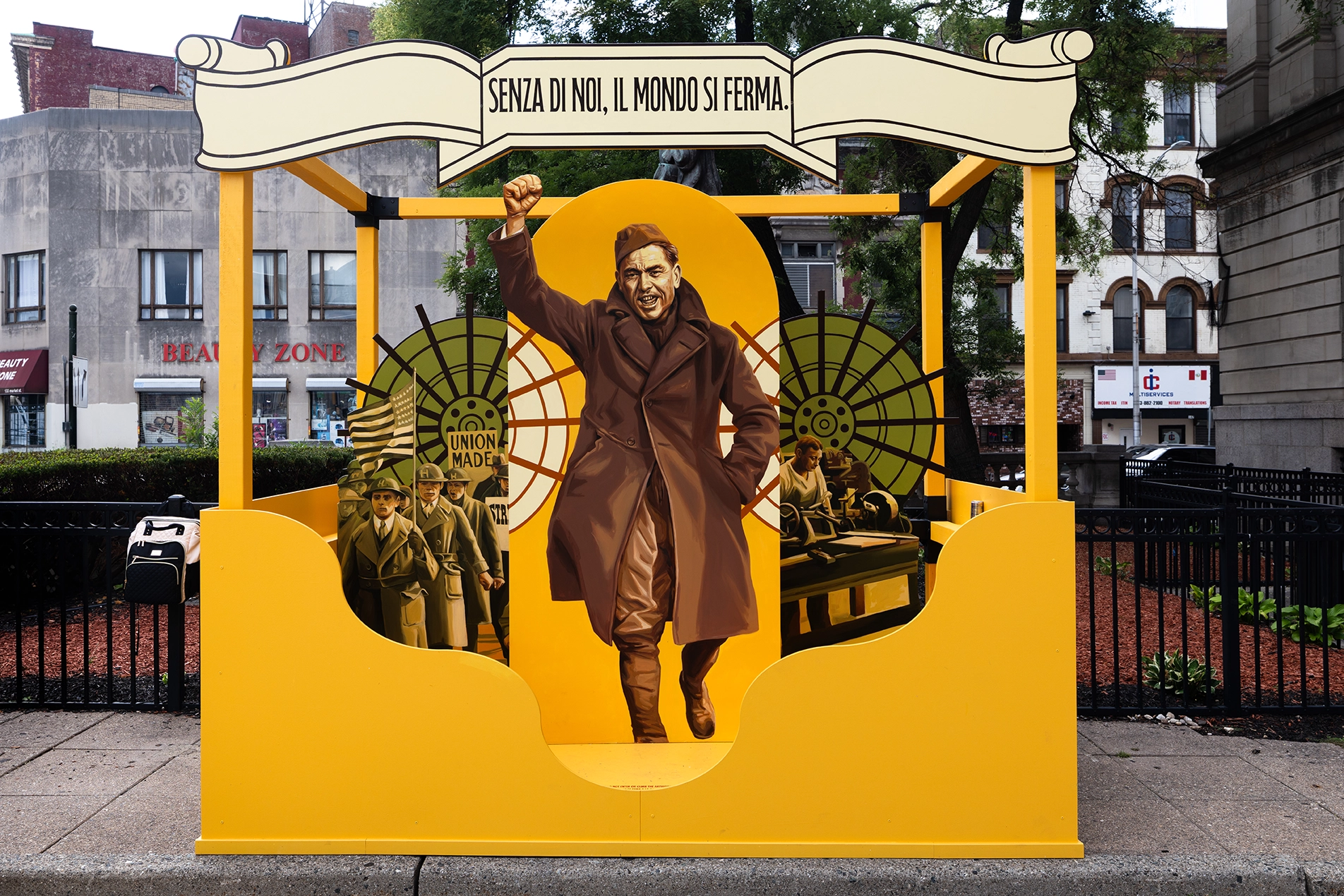
Photo by Steve Weinik.
Solidarity Forever
“Singing Solidarity Forever,” 1926, American Labor Museum/Botto House National Landmark Collection, New Jersey Digital Highway.
In January 1926, more than 15,000 woolen mill workers in Passaic, Clifton, and Garfield New Jersey, went on strike. They demanded that owners reverse a ten percent reduction in pay introduced the previous year, and that a 44-hour work week be implemented. Led by Communist Party-affiliated organizers, mass support for the strike spoke to the brutal working conditions in the mills, and to the poverty wages paid to the primarily Hungarian, Polish, and Slovakian workforce living in Passaic and adjoining Clifton. The Botto House in Haledon, as had been the case during the 1913 Paterson Silk Strike, served as an important rallying point for strikers.
Industrial Life
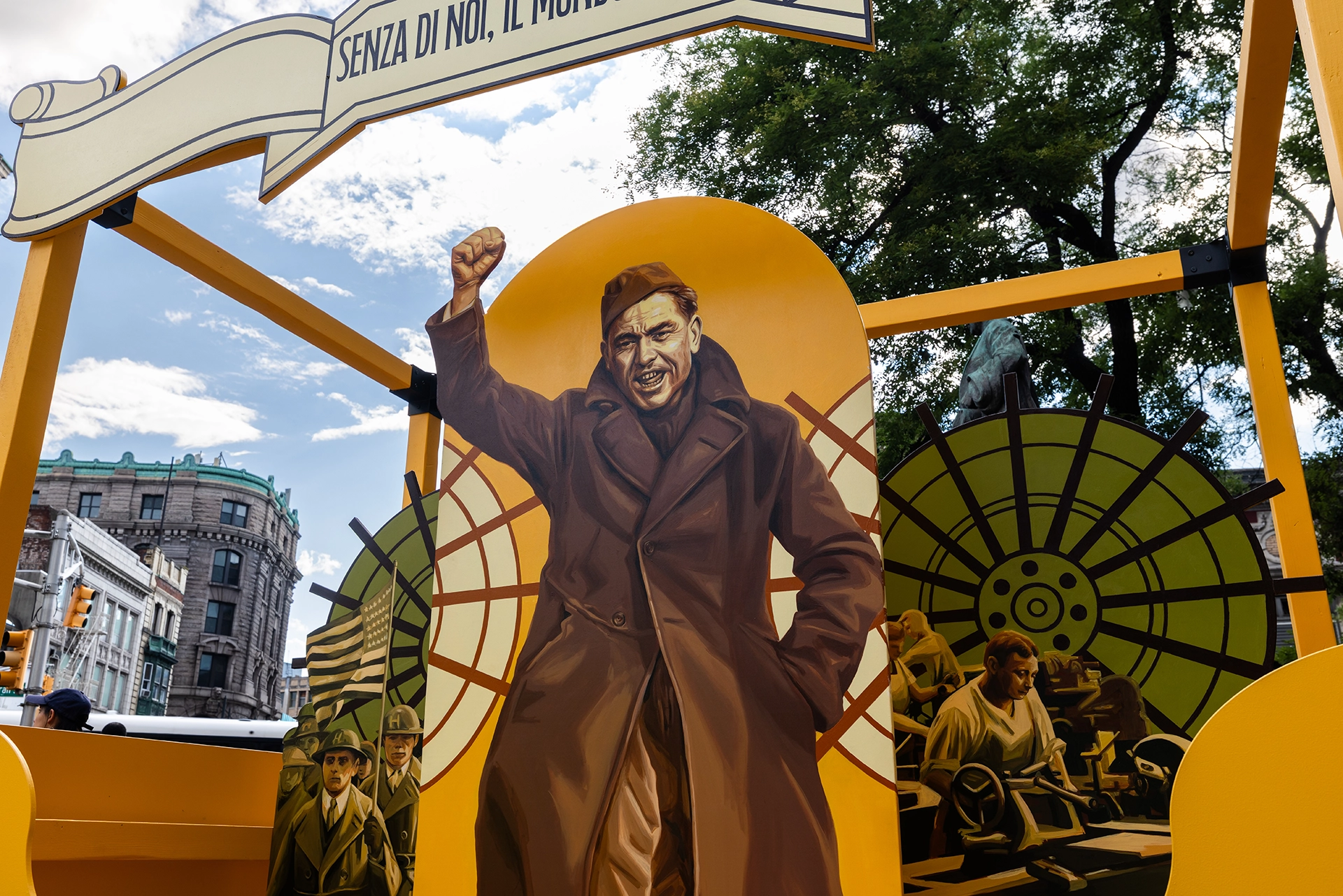
“Strikers March,” 1926, American Labor Museum/Botto House National Landmark Collection, New Jersey Digital Highway.
Untitled photograph, Paterson Museum.
The Ackerman Avenue bridge over the Passaic River, which separates Clifton from Garfield, emerged as a major site of conflict, and may be the location where the illustrated photograph, appearing on the left side of the monument, was taken. Workers at the Botany Mills site, located in Clifton, tried to cross the river and join fellow picketers at the Forstmann & Huffman mills. After numerous clashes between picketers and company guards and police, on February 25, 1926, the Passaic City Council issued a “Riot Act,” barring protestors from the streets. This led the ACLU and other Civil Rights organizations to issue formal complaints on behalf of the strikers. The strike continued until March 1927, when mill owners and union representatives reached an agreement. As was often the case, despite management’s promises to rehire picketing workers, many were denied their old positions as a result of taking part in the strike.
The photograph on the right side of the monument was taken in the first decade of the twentieth century, and is part of the Paterson Museum’s collections. It depicts a machine shop at an unnamed mill operating in the city. Larger mills and factories had specialized machines and tools that they manufactured and repaired on site.
Monument 5: Descendants
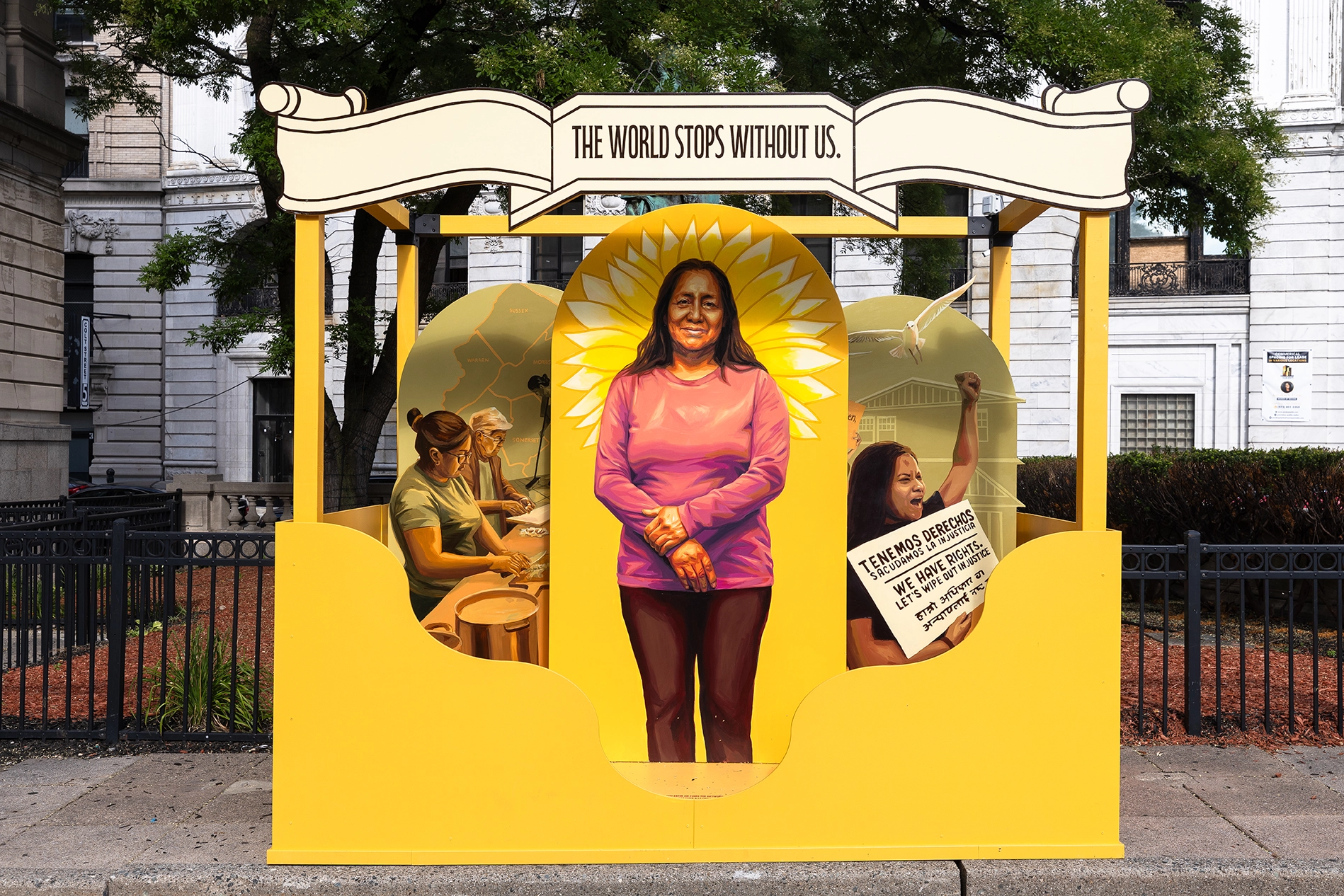
Photo by Steve Weinik.
Mariana Jimenez
“Descendants” serves as a companion piece to “Ancestors,” which it faces in conversation, and centers the contemporary organizing efforts of women workers. “Descendants” specifically focuses on paid domestic labor, caregiving, and other service jobs that in North Jersey and many other parts of the United States, rely on immigrant women of color. At the center of the monument, Mariana Jimenez, an Ecuadorian immigrant standing strong and stoic as representative of the domestic workers rights’ movement, appears in monumental form as a symbol of immigrant leadership and advocacy. She is an organizer and activist, not just a laborer, and stands as such. Mariana is framed by a large sunflower, inspired by a flyer from the American Labor Museum. Since 1867, when Kansas suffragists first adopted the sunflower as their symbol, the flower’s golden-yellow color has repeatedly featured in the visual imagery of different women’s rights movements across the United States.
Organizing
To the viewer’s left, a photo collage shows a domestic worker sweeping while a multigenerational group of food workers prepare and share food, illustrating the interconnected nature of domestic labor, caregiving, and food work. Above the pictured figures, two white gaviotas appear in flight, symbolizing freedom, migration, and the ongoing pursuit of dignity. As a contemporary counterpart to "Ancestors," the monument draws upon present-day labor rights movements, including those that led to the successful passage of the New Jersey Domestic Workers' Bill of Rights that went into effect in 2024. “Descendants” recognizes the continued organizing efforts of women whose labor remains essential to their own communities, and to the millions of New Jersey residents who are dependent on their paid labor.
To the viewer’s right, an immigrant nurse holds a multilingual protest sign calling for rights and justice for careworkers.
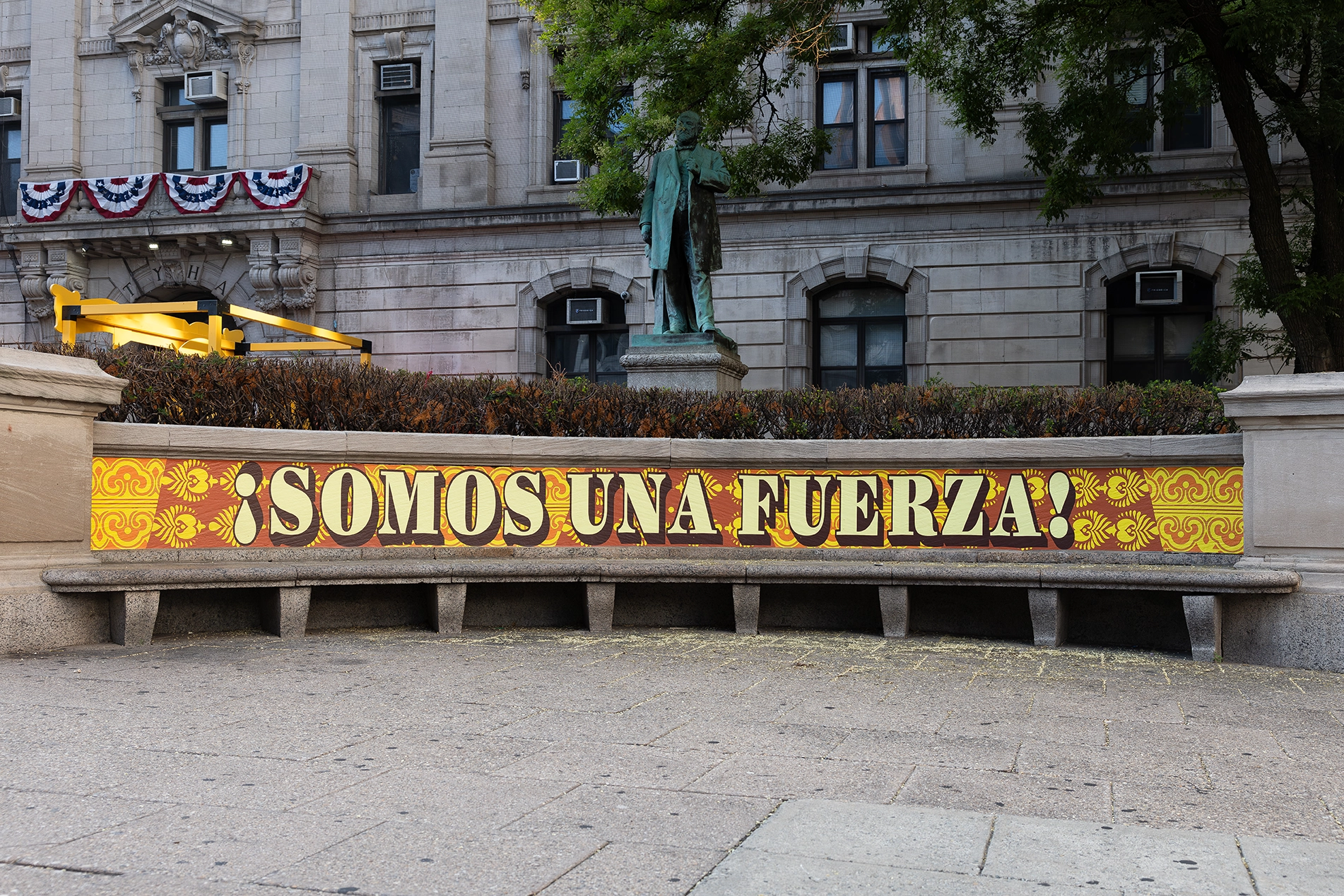
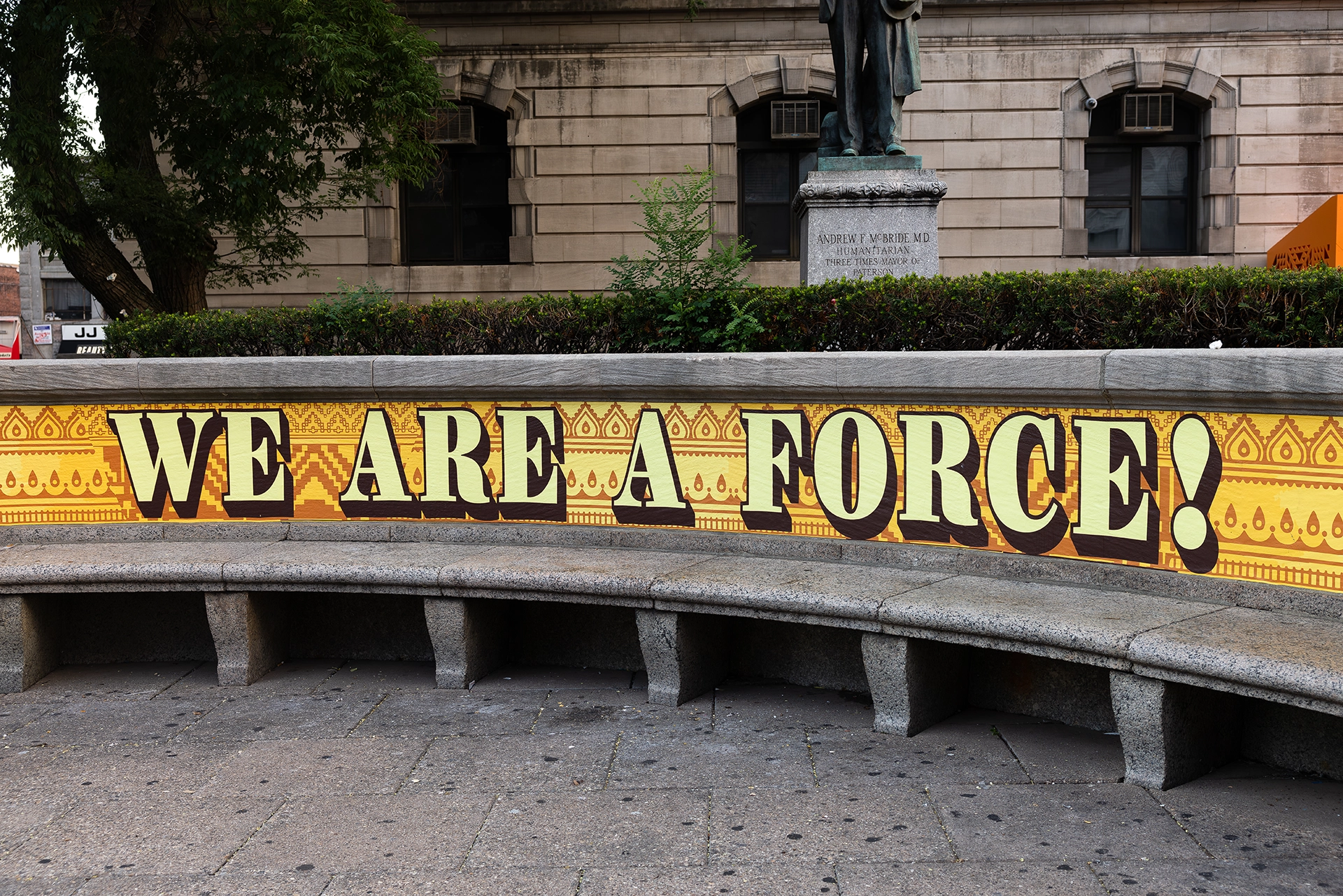
Photo by Steve Weinik.
NJMML is grateful to Lucy Baptiste, whose photographs on behalf of New Labor appear in “Descendants.” Active throughout New Jersey, New Labor, an NJMML project partner, has worked tirelessly to organize against wage theft, illegal working conditions, ICE raids, and for the rights of domestic and temporary workers in the state. Baptiste’s photographs highlight immigrant workers’ dignity and mutual care, as a tenet of solidarity.


About NJMML
NJ Monuments To Migration And Labor is a three-year initiative honoring immigrants’ contributions to the state. Through public events, and monument installations, it celebrates their resilience, hard work, and cultural impact, blending art, history, and storytelling to inspire reflection and appreciation.